NCHC Employs Open Hackathons and Bootcamps to Usher in a New Era of Accelerated Computing
As the world experiences explosive growth in AI, mastering Sovereign AI and AI for Science has become a critical national strategy for Taiwan. Long recognized as a global semiconductor powerhouse, Taiwan is rapidly transforming its economy to become an “AI Island,”[1] unveiling the “Ten Major AI Infrastructure Projects” and enacting the AI Basic Act.[2]
A cornerstone of these initiatives is a new cloud computing center of the National Center for High-performance Computing (NCHC), which houses the Nano 4 supercomputer. Equipped with 1,760 NVIDIA® H200 Tensor Core GPUs and 144 NVIDIA Blackwell-architecture GPUs, the Nano 4 delivers approximately 7 FP8 Exaflops of computing performance, representing a massive leap in the island's computational capabilities.[3]
While state-of-the-art infrastructure is crucial, elite talent is also required to harness this unprecedented computing power and maximize its potential. To help develop this talent, the NCHC hosted a robust training program that included a series of five skills-building bootcamps covering essential accelerated computing topics and tools, and culminated in the 2025 NCHC Open Hackathon.
Laying the Foundation: Bootcamps Cultivate Critical Skills
AI is developing faster than almost any other major technology in history, driving rapid advances in scientific discovery from bigger, better protein sequencing models to leading large language models (LLMs) that improve detection, prediction, and risk management. This growth is breakneck and only picking up speed.
These advances are not without their challenges for researchers and developers, including: the rapidly changing landscape of models, frameworks, and architectures; computational resource limitations; data challenges; and how to best bridge domain knowledge with accelerated computing proficiency.
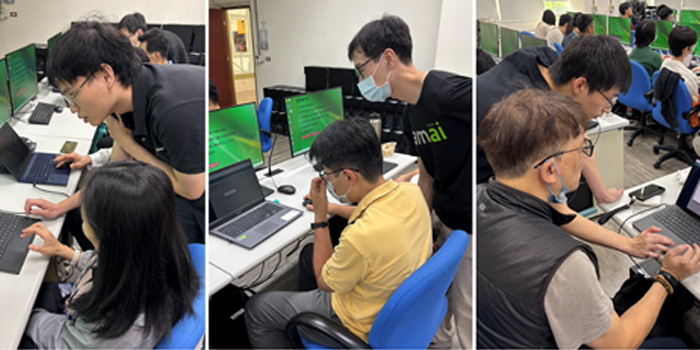
NCHC worked collaboratively with the OpenACC Organization and NVIDIA to deliver five bootcamps that bolstered researchers’ skills. With attendance per event averaging between 70-100+ participants, each bootcamp focused on a specific area—from selecting the right programming model for their project to exploring new tools for AI for Science to understanding and implementing Quantum AI—and provided foundational, hands-on skills that researchers could immediately apply to their work. Additionally, the Bootcamps outlined resources so participants could continue their development.
Continued training events are expected in 2026, with the NCHC AI-Powered Physics Bootcamp scheduled for March 10th to 11th.
Tying It All Together: NCHC Open Hackathon Empowers Innovation
The NCHC Open Hackathon is an annual event that brings top academic research teams together with expert mentors to leverage next-generation architectures and tools. The 2025 event continued its tradition of “pushing your limits”[4] for its attendees, only competing against their previous progress. This winning combination enabled teams at the event to tackle complex scientific challenges, solve computational bottlenecks, and achieve significant speedups that accelerated their applications across multiple disciplines.
Revolutionizing Climate Modeling and Preparedness
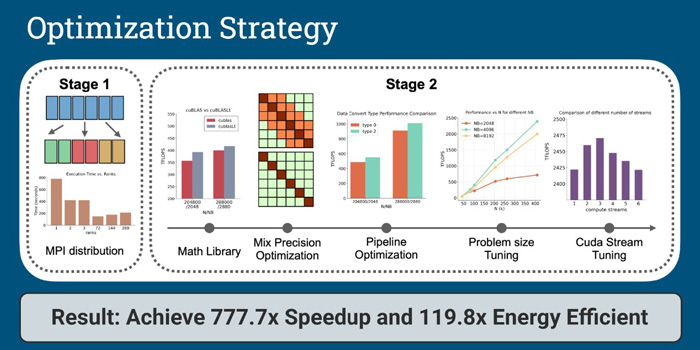
Team “Usagi” led by Professor Chun-Yi Lee from National Taiwan University, expanded on work with the Exascale Climate Emulator (ECE),[5] leveraging Spherical Harmonic Transform (SHT) to solve the highly complex and time-consuming challenges of high-resolution global climate simulation. With intensive mentoring, mixed-precision optimization, problem size tuning, and other adjustments, the team achieved an astounding 777x acceleration. Additionally, Team Usagi estimated a 119x reduction in energy consumption, saving an estimated 5,056 tons of CO2 emissions—proving that high-performance computing (HPC) is a key driver for environmental sustainability.
Besides the countless lives that could be saved by typhoon preparedness, predicting typhoons is vital for wind farms to head off structural failures, reduce operational damage, and manage power grid stability, as these critical renewable energy system infrastructures are especially vulnerable to extreme weather systems.[6] Team CYCU Power Lab from Chung Yuan Christian University focused on enhancing a hybrid quantum-classical deep learning system combining Temporal Fusion Transformers (TFTs) with a Quantum Long Short Term Memory (QLSTM). By experimenting with different architectures and NVIDIA CUDA-Q™, they reduced model training time from over 3 days to just 4 hours, achieving a nearly 9x increase in training throughput.
AI and Quantum Meet Material Science
Traditional methods within materials science are often costly and slow due to the wide variety and quantity of materials, plus the reliance on manually-written rules and extensive “trial and error” experiments. Team Qa-MolGen worked on a quantum-based molecular generation (QMG) model, utilizing NVIDIA CUDA-Q and a tensornet backend to make the discovery of new heavy-element materials significantly more efficient. They successfully accelerated their model by 5,417.9 times, creating a navigation tool they liken to a “Google Maps” for materials science that helps scientists efficiently discover new materials while drastically reducing the cost of physical experiments.
Accelerating Plasma Simulation
Team PTSG Taiwan, led by Professor Ming-Chieh Lin of National Taipei University of Technology, focused on electromagnetic plasma simulations using a particle-in-cell (PIC) Monte Carlo collision (MCC) code developed by the Plasma Theory and Simulation Group (PTSG). The team used NVIDIA Nsight™ Systems to identify and understand the computational bottlenecks, then implemented OpenACC, a directives-based programming model, to offload the existing C++-based code of their application to the GPU. Team PTSG Taiwan successfully achieved a more than 15x acceleration in double-precision calculations, exceeding expectations and laying the groundwork for an optimal simulation platform for advanced plasma processes.
Advancing Computer Vision and 3D Reconstruction
Understanding vegetation vitality and conditions is important for many industries, from agriculture to environmental services. Using image sensing in combination with indices such as the Normalized Difference Vegetation Index (NDVI) helps to gauge the health and density of vegetation in land areas effectively.[7] Tasked with stitching hundreds of high-resolution images into panoramic maps or 3D models, the Ndvignition team from National Tsing Hua University worked with their mentors to accelerate their SfM (Structure for Motion) workloads using GPUs. The optimization cut processing time from 1 hour to just 20 minutes (a 5.36x speedup), enabling rapid, on-the-ground decision-making for agricultural surveys and disaster assessment.
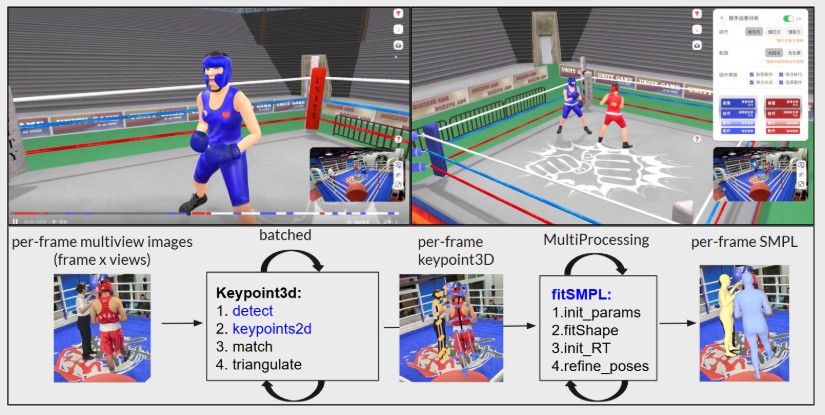
Another team from National Tsing Hua University, Team Paw Patrol, focused on 3D human pose reconstruction using a combination of deep learning for human detection and 2D keypoint estimation, followed by optimization-based human mesh fitting (Simple Model of Body Shape and Pose [SMPL]) for each detected person. The team used NVIDIA Nsight Systems to analyze their pipeline and identify GPU idle times. By redesigning their inference architecture from a view-axis batch to a time-axis batch, they eliminated sequential bottlenecks, resulting in an 8.5x acceleration.
What’s Next?
By combining world-class infrastructure and hands-on mentoring, the NCHC Open Hackathon enabled researchers to accelerate months or even years of development work into just a few weeks.
NCHC will be hosting additional training and development opportunities in 2026, including the NCHC AI-Powered Physics Bootcamp. Scheduled for March 10-11, 2026, this bootcamp focuses on helping attendees to apply physics-informed AI to their domain, understand when to leverage physics constraints versus data-driven approaches, and how to visualize and validate their results. Apply now.
References
1) H. Ryugen, "Taiwan plans to spend $3bn to pursue 'AI island' ambitions," NIKKEI Asia, 18 November 2025. [Online]. Available: https://asia.nikkei.com/business/technology/artificial-intelligence/taiwan-plans-to-spend-3bn-to-pursue-ai-island-ambitions. [Accessed 20 February 2026].
2) K.-Y. Tseng, "Taiwan's strategic leap into AI: Enacting the AI Basic Act to foster innovation, governance," The IAPP, 5 February 2026. [Online]. Available: https://iapp.org/news/a/taiwan-s-strategic-leap-into-ai-enacting-the-ai-basic-act-to-foster-innovation-governance. [Accessed 20 February 2026].
3) "AI 浪潮來襲,NCHC 2025 Open Hackathon點燃加速運算新紀元," National Center for High-Performance Computing, 12 November 2025. [Online]. Available: https://www.nchc.org.tw/Message/MessageView/4040?mid=46&page=1. [Accessed 6 February 2026].
4) "國網中心及 NVIDIA、OpenACC 舉辦「2025 NCHC Open Hackathon」黑客松,與台灣卓越研究團隊探索新世代 GPU 技術大幅加速強最新 AI 、量子運算等研究的嶄新技術創新," TechOrange, 22 January 2026. [Online]. Available: https://techorange.com/2026/01/22/nchc-open-hackathon-report-nvidia/. [Accessed 05 February 2026].
5) S. Abdulah et al., Boosting Earth System Model Outputs and Saving Petabytes in Their Storage Using Exascale Climate Emulators, IndySCC/SCC Webinar, SC25, 31 Jul. 2025. [Online]. Available: https://sc25.supercomputing.org/wp-content/uploads/2025/07/IndySCC_SCC_25_Webinar_Exascale_Climate_Emulator.pdf. [Accessed: Feb. 20, 2026].
6) Y. -Y. Hong, D. J. O. Medina and Y. -Y. Wang, "Extreme Weather Forecasting Using Quantum-Enhanced LSTM Network," 2025 IEEE Industry Applications Society Annual Meeting (IAS), Taipei, Taiwan, 2025, pp. 1-8, doi: 10.1109/IAS62731.2025.11061382.
7) "What is NDVI and its Fundamental Advantages," Geoimage, 22 May 2024. [Online]. Available: https://geoimage.com.au/blog/what-ndvi-and-its-fundamental-advantages. [Accessed 22 February 2026].
* This article includes a recap of the Chinese-language article about the NCHC Open Hackathon as first reported on TechOrange on January 22, 2026.
Author